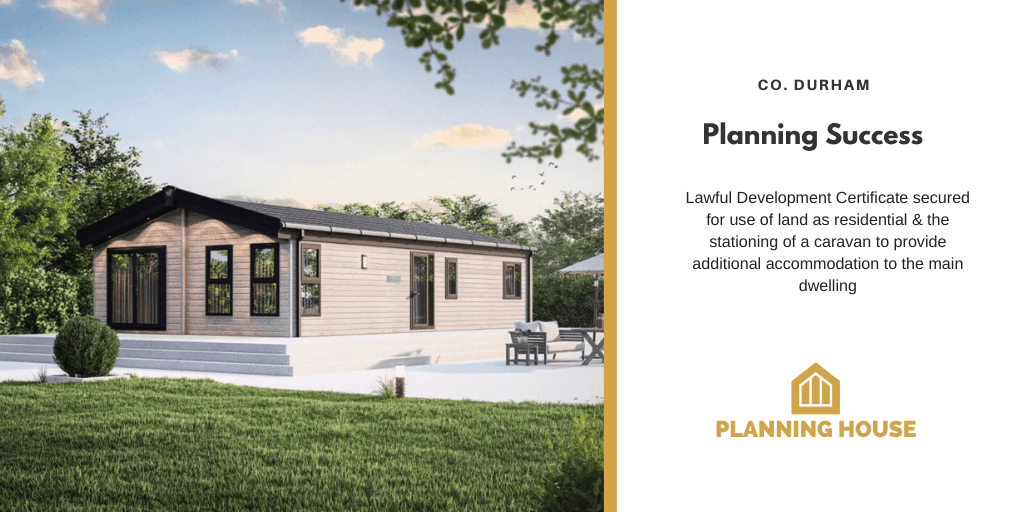
Planning House is pleased to confirm the successful granting of a Certificate of Lawfulness (Existing Use) for use of land and caravan in Bournmoor, Houghton-le-Spring. The decision confirms the lawful residential use of land as domestic garden and the siting of a caravan used as additional accommodation to the main dwelling.
This case highlights the importance of robust evidence-based planning applications and demonstrates how lawful development certificates can provide certainty for homeowners and landowners.
Understanding the Application
The application sought confirmation of two key elements:
- The lawful use of land to the west of the property as residential garden curtilage; and
- The lawful siting of a caravan providing additional accommodation to the main dwelling
The site is a detached property within a predominantly residential area in Bournmoor, with established domestic use and historic planning permissions relating to extensions and alterations to the dwelling.
Key Planning Considerations
Unlike full planning applications, a Certificate of Lawfulness does not assess planning merits. Instead, it is a legal determination based on whether the use or development is lawful under the Town and Country Planning Act 1990.
The key legal tests considered include:
- Whether the use has existed continuously for at least 10 years;
- Whether the unit falls within the statutory definition of development, ie a building not a caravan used for additional accomodation; and
- Whether sufficient evidence is provided on the “balance of probability”
Residential Use of Land Confirmed as Lawful
A range of evidence was submitted to demonstrate the land had been used as part of the domestic curtilage of the property for over 10 years, including: Historic aerial imagery, Google Earth mapping data, neighbour statements and previous planning application site plans.
Despite objections from neighbours questioning the extent and continuity of use, the Durham County Council, acting as Local Planning Authority concluded that the evidence demonstrated the land had been consistently used as part of the residential garden associated with main property. As a result, it was confirmed that the land forms part of a single planning unit and benefits from lawful residential use.
Caravan Use Determined to be Lawful Additonal Accommodation
The second element of the application considered whether the siting of a caravan constituted development requiring planning permission. The caravan was assessed against the legal definition set out in the Caravan Sites and Control of Development Act 1960 and the Caravan Sites Act 1968.
Key findings included:
- The structure met the technical definition of a twin-unit caravan;
- It was not permanently fixed to the ground; and
- It was capable of theoretical mobility.
The Local Planning Authority also considered whether its use created a separate planning unit. On balance, it was concluded that, the caravan is occupied by family members, sharing access and domestic facilities with the main dwelling and fundamentally it functions as additional accommodation, not a separate dwelling.
Therefore, no material change of use was identified.
Planning Decision Outcome
The Council concluded that the residential use of the land as garden curtilage is lawful (10+ years continuous use proven) and the caravan constitutes lawful additional accommodation and does not amount to development requiring permission.
Accordingly, a Certificate of Lawfulness under Section 191 of the Town and Country Planning Act 1990 was granted.
This case demonstrates:
- The importance of strong documentary and visual evidence in planning law;
- How lawful development certificates provide certainty for homeowners;
- The distinction between additional accommodation and separate residential units; and
- The legal thresholds applied in planning enforcement immunity cases.
At Planning House, we specialise in supporting clients through complex lawful development and planning certificate applications, ensuring evidence is presented clearly and effectively to achieve successful outcomes.
Need Help With a Lawful Development Certificate?
If you are unsure whether your development or existing use is lawful, our team can help assess your case and prepare a strong application based on planning legislation and case law.
Related Content:
Our FREE Practical Guides cover the basics of for Certificate of Lawful Proposed Use or Development (CLPUD) and Certificate of Lawful Existing Use or Development (CLEUD) are available on our website, along with examples of certificate of lawful development schemes we’ve been involved in – Collections – All Things Certificate of Lawfulness.
However, if you need assistance then don’t hesitate to Contact Us for a free initial consultation If you’re not sure if you need help from a Town Planner take a look at blog on When to Hire a Town Planner our download a Guide on How to Choose a Town Planner.