Children’s homes play a vital role in supporting vulnerable young people, often providing stable and supportive environments within residential communities. However, proposals for children’s homes can raise unique planning considerations, particularly around location, community integration and potential impacts on neighbouring residents.
One of the most common questions we receive is: does a children’s home require planning permission? The answer is not always straightforward.
In some cases, planning permission will be required. In others, a proposal may not constitute a material change of use, meaning permission may not be necessary. This article explains how planning authorities assess children’s home proposals and when planning permission may be required.
Understanding Use Classes: C3 vs C2
In planning terms, most houses fall under Use Class C3, which relates to standard residential dwellings. Children’s homes are categorised under Use Class C2, which covers residential institutions such as:
-
Residential care homes
-
Children’s homes
-
Residential schools
-
Hospitals and nursing homes
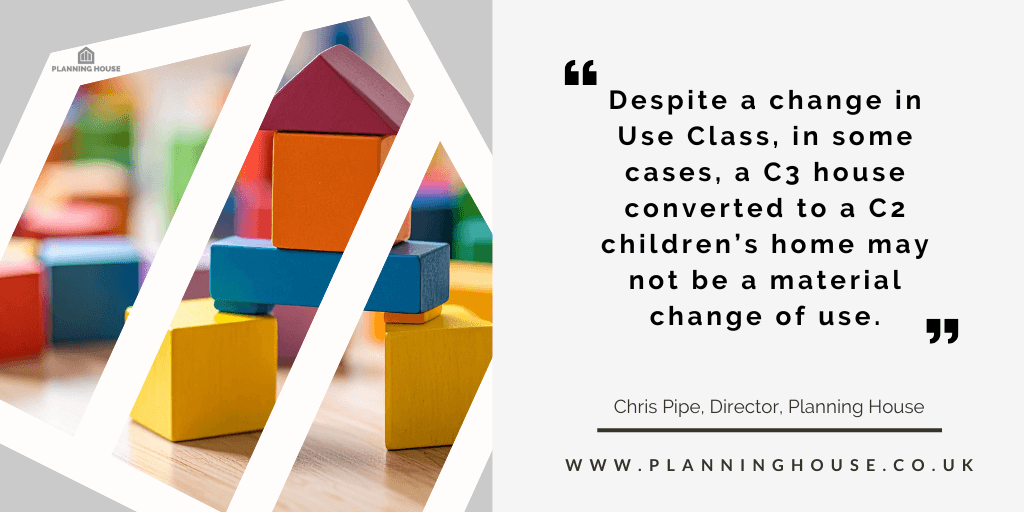
At first glance, moving from a C3 dwelling to a C2 children’s home may appear to be a significant change. However, planning decisions often depend on whether the change represents a “material change of use”. Just because there is a change of use class doesn’t mean that a material change of use has occurred.
What Is a Material Change of Use?
A material change of use occurs when the nature or intensity of an activity changes enough to affect:
-
The character of the property
-
The character of the surrounding area
-
Neighbouring amenity
-
Traffic, parking or activity levels
If the change is considered material, planning permission is required.
If the change is not material, planning permission may not be necessary.
Our blog Understanding Material Change of Use: When Does a Development Require Planning Permission? is a good place to start looking at this further.
When Planning Permission May Not Be Required
In some situations, converting a family home into a children’s home may not represent a material change of use.
This can occur where the proposed use closely resembles how the property would operate as a standard family household.
For example:
-
The home accommodates a small number of children, often three or fewer, however there are cases where more children can be accommodated;
-
Staffing levels are modest, typically two carers on shift with sensitive rota change over;
-
The home operates as a family-style household rather than an institution; and
-
Traffic levels, visitors and activity remain similar to a normal dwelling.
Where the scale and intensity of the use remain broadly comparable to a family home, planning authorities or planning inspectors may determine that no material change of use has occurred.
There are numerous appeal decisions and planning approvals that support this approach.
When Planning Permission Is Likely to Be Required
In other circumstances, local planning authorities may consider the proposed use to be materially different from a normal dwelling. Factors that can influence this decision include:
-
A larger number of residents
-
Increased staffing levels
-
Regular staff shift changes
-
Increased vehicle movements or visitor activity
-
A more institutional form of care provision
Where the level of care or operational intensity significantly alters the way the property functions, the authority may conclude that there is a material change of use and requires planning permission.
Why Location Matters
Children’s homes are often best located within residential communities, allowing young people to access schools, services and social activities. Planning authorities therefore commonly assess whether the site provides:
-
Good access to local services and facilities;
-
Proximity to schools and healthcare provision;
-
Public transport accessibility; and
-
Opportunities for community integration.
These factors help ensure that children living in care can participate in everyday life within their community.
Residential Amenity Considerations
Local authorities will also consider whether the proposal could affect neighbouring residents.
Typical concerns include:
-
Noise or disturbance;
-
Parking pressures;
-
Increased comings and goings; and
-
Changes to the character of the street.
However, small children’s homes operating with a family-style model of care often generate activity levels similar to those of a traditional family household. Where this is the case, planning officers frequently conclude that the impact on residential amenity is limited.
Seeking Professional Advice
Determining whether a proposal represents a material change of use can be complex and depends heavily on the specific details of the scheme.
Before progressing with a children’s home project, it is often advisable to seek professional planning advice or obtain confirmation from the local planning authority.
In some cases, applicants may submit a Lawful Development Certificate to formally confirm that planning permission is not required. Our collection on All things Certificate of Lawfulness may help you decide your route.
Supporting the Delivery of Children’s Homes
Children’s homes provide essential support for young people who need stability, care and safe living environments.
When appropriately located and sensitively managed, these homes can successfully operate within residential communities while supporting positive outcomes for children.
Understanding the planning framework and potential requirements is an important step in delivering these much-needed facilities.
Need Advice on a Children’s Home Planning Proposal?
If you are considering converting a property into a children’s home or are unsure whether planning permission is required, our planning consultants can help. Contact our team today to discuss your project.